Project · 2022–present · Saeed Rafieyan, lead developer
MLATE
Machine Learning Applications in Tissue Engineering: publicly available models and data that predict how a scaffold will print and how cells will respond to it, rank candidate formulations, and suggest what to fabricate next.
- Role
- Lead developer
- Methods
- Gradient boosting, deep and tabular foundation models, Bayesian optimisation, LLM-assisted protocol generation
- Data
- Literature-derived scaffold dataset, published with the code
Versions
| Version | Year | Scope | Paper |
|---|---|---|---|
| V1 | 2023 | Cardiac scaffolds; 28 algorithms benchmarked for cell behaviour | Computers in Biology and Medicine |
| V2 | 2024 | 3D (bio)printed scaffolds; 1,171 scaffolds, 60 biomaterials, 49 cell lines | Biofabrication |
| V3 | 2026 | Multi-tissue; WSSQ ranking, Bayesian optimisation and a public web app | Biofabrication |
About
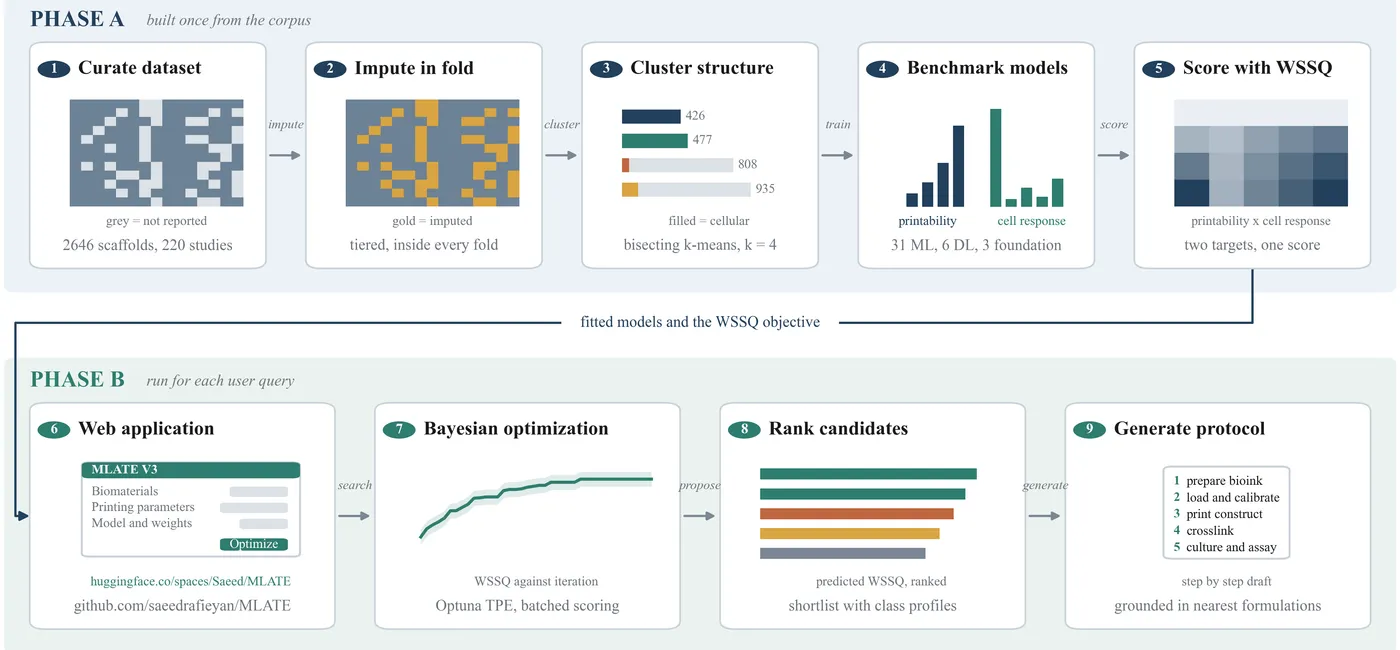
Designing a tissue-engineering scaffold means choosing biomaterials and their concentrations, cell types and densities, and printing conditions, then running experiments to see what works. Most of that search is still trial and error. MLATE turns the published literature into structured datasets and trains models that predict the outcome from variables known before fabrication.
What it does
- Predicts cell response and printability from pre-fabrication variables. In V3 the best models reach weighted F1 scores of 0.773 (cell response) and 0.806 (printability).
- Ranks candidates with the Weighted Synergistic Scaffold Quality (WSSQ) score, which combines both predictions with adjustable weights.
- Optimises formulations and printing parameters inside a user-defined design space with Bayesian optimisation.
- Plans experiments: an LLM-assisted module drafts step-by-step fabrication protocols for the shortlisted candidates.
The aim is to narrow the experimental search space and suggest candidates worth testing, not to replace experimental validation.
Try it
The web app runs at MLATE, and the code, datasets and analysis pipeline are on GitHub.
How to cite
@article{rafieyan2026mlate,
  title     = {{MLATE V3: An Open-Source Multi-Tissue AI Framework for Data-Driven Optimization of 3D-Printed and Bioprinted Scaffolds}},
  author    = {Rafieyan, Saeed and Partovi Nasr, Minoo and Ansari, Elham and Kheradvar Kolour, Alireza and Banimohamad-Shotorbani, Behnaz and Vasheghani-Farahani, Ebrahim},
  journal   = {Biofabrication},
  year      = {2026},
  month     = oct,
  doi       = {10.1088/1758-5090/aeb162},
  note      = {In press}
}
Related publications
MLATE: Machine learning for predicting cell behavior on cardiac tissue engineering scaffolds
Computers in Biology and Medicine ·
Predicting cell behavior on cardiac tissue engineering scaffolds using machine learning algorithms
MSc thesis, Tarbiat Modares University, Tehran ·